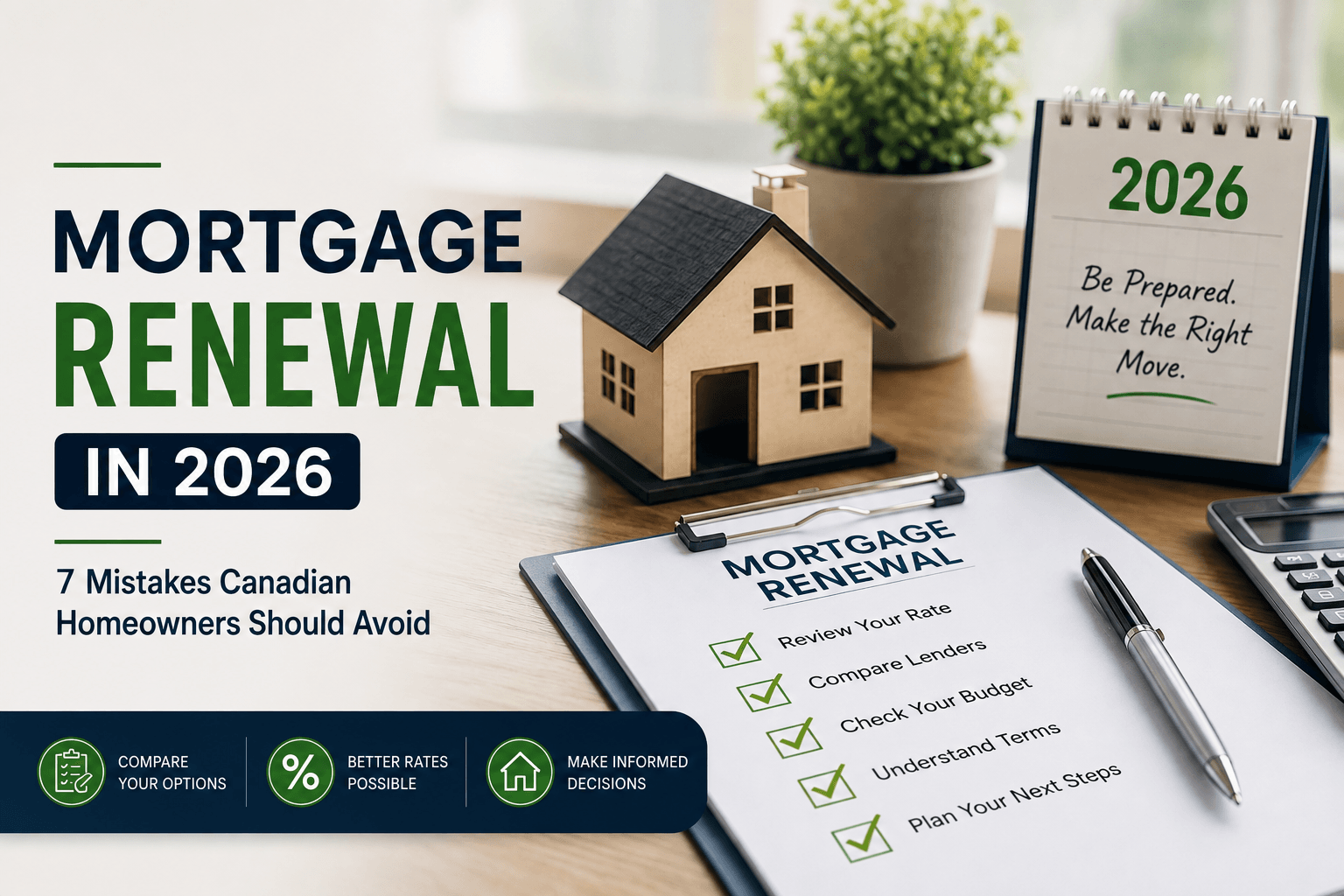
If your mortgage term is coming to an end in 2026, you may be wondering whether you should simply accept your lender’s renewal offer or take the opportunity to review your options.
For many Canadian homeowners, mortgage renewal is more than just signing a new contract. Your interest rate, monthly payment, amortization, mortgage term, prepayment options and long-term financial goals can all be affected by the decision you make at renewal.
The Bank of Canada has estimated that around 60% of outstanding Canadian mortgages were expected to renew during 2025 or 2026. Its analysis also found that many borrowers renewing during this period could face higher payments compared with their previous mortgage terms.
At the same time, the mortgage market continues to change. The Bank of Canada held its overnight policy rate at 2.25% in July 2026, while mortgage rates and lender pricing can vary depending on the borrower, mortgage type and lender.
That makes it especially important to prepare before signing your next mortgage agreement.
What Is a Mortgage Renewal?
A mortgage renewal happens when your current mortgage term ends and you still have an outstanding balance to repay.
A mortgage term is the period covered by your current mortgage agreement. It may be a few months, one year, three years, five years or another period depending on the mortgage you selected.
When the term ends, you generally need to renew the mortgage unless you are paying off the balance in full or moving to another financing arrangement.
Mortgage renewal gives you an opportunity to review your financing instead of simply continuing with the same arrangement.
You can potentially:
- Negotiate a different interest rate
- Choose a different mortgage term
- Consider fixed or variable options
- Change lenders
- Adjust your amortization
- Review prepayment privileges
- Consider mortgage refinancing if your financial needs have changed
The right choice depends on your financial situation and future plans.
7 Mortgage Renewal Mistakes to Avoid in 2026
1. Automatically Accepting Your Lender’s Renewal Offer
One of the biggest mortgage renewal mistakes is assuming that the renewal offer from your current lender is automatically the best option.
Your existing lender may send you a renewal notice with an interest rate and new mortgage terms. While accepting the offer can be convenient, convenience does not necessarily mean you are getting the most suitable mortgage.
Other lenders may offer different rates, terms or features that could better match your financial goals.
Before renewing, compare your current lender’s offer with other available mortgage options.
A small difference in interest rate can make a meaningful difference over the life of your mortgage, particularly when you have a large outstanding balance.
Tip: Do not wait until the last few days before your mortgage expires. Give yourself enough time to compare options and understand the costs involved in switching lenders.
2. Waiting Until the Last Minute
Mortgage renewal should not be treated as a last-minute task.
If your mortgage term is ending soon, start reviewing your options well in advance. Waiting until the final week can leave you with fewer choices and less time to negotiate.
For federally regulated financial institutions, lenders are generally required to provide a renewal statement at least 21 days before the end of the existing term. However, receiving a renewal statement does not mean you should wait until then to start planning.
Starting early gives you time to:
- Review your financial position
- Check your credit
- Compare lenders
- Understand current mortgage options
- Review your outstanding mortgage balance
- Consider whether your income or expenses have changed
- Discuss your options with a mortgage professional
An early review can make the renewal process more organized and less stressful.
3. Focusing Only on the Interest Rate
Interest rate is important, but it should not be the only factor you consider when renewing a mortgage.
A mortgage with a slightly lower rate may not necessarily be the best option if it comes with restrictions that do not fit your plans.
For example, you should also consider:
- Mortgage term
- Fixed or variable rate
- Prepayment privileges
- Penalties for breaking the mortgage
- Portability
- Payment frequency
- Amortization period
- Flexibility to make additional payments
- Conditions associated with refinancing or switching lenders
Think about how your financial situation may change during the next mortgage term.
If you expect to sell your home, make large lump-sum payments or refinance in the future, mortgage flexibility may be particularly important.
The goal should be to find a mortgage that fits your overall financial situation rather than simply choosing the lowest advertised rate.
4. Ignoring Your Financial Situation Before Renewal
Your financial circumstances may be very different from when you originally obtained your mortgage.
Perhaps your income has increased. Maybe you have taken on new debt, paid off credit cards, changed jobs or started planning for another major expense.
Before renewing, take a fresh look at:
- Household income
- Monthly expenses
- Credit card balances
- Personal loans
- Lines of credit
- Car payments
- Savings
- Emergency funds
- Mortgage balance
- Short- and long-term financial goals
This review can help you understand how comfortable you would be with different mortgage payments.
CMHC’s 2026 mortgage industry reporting noted that although the mortgage renewal wave has passed its peak, many renewing borrowers continue to face higher interest costs, while household financial pressure remains uneven across regions and borrowers.
Understanding your own financial position is therefore an important part of preparing for renewal.
5. Assuming a Longer Amortization Is Always Better
Extending your amortization can reduce your monthly mortgage payment, but it can also increase the total amount of interest you pay over time.
For example, spreading your mortgage balance over a longer period may make your monthly budget more manageable, but you could remain in debt longer and pay more interest.
The Financial Consumer Agency of Canada specifically warns homeowners to think carefully before extending amortization simply to lower payments because the additional interest costs can become substantial.
Before changing your amortization, compare:
Lower monthly payment vs. total interest cost
If your financial situation allows you to maintain a shorter amortization, that may help you pay down your mortgage faster. However, the appropriate choice depends on your income, expenses, debt obligations and financial goals.
6. Not Comparing Mortgage Lenders
Another common mistake is assuming that staying with your current lender is always the easiest or best choice.
At renewal, you may have an opportunity to explore mortgage options from other lenders.
A mortgage broker can help you compare different financing solutions based on your financial circumstances rather than limiting the search to one institution.
Depending on your situation, available options may include:
- Major banks
- Credit unions
- Alternative lenders
- Other mortgage lending institutions
However, switching lenders can involve costs or additional requirements depending on the circumstances.
For example, you should understand whether there are appraisal, legal or administrative costs and whether your new mortgage provides the features you need.
A proper comparison should look beyond the headline interest rate.
7. Forgetting to Consider Your Future Plans
A mortgage should support your financial plans—not work against them.
Before choosing a new mortgage term, think about what you expect over the next few years.
Are you planning to:
- Move to another home?
- Renovate your property?
- Make a large lump-sum mortgage payment?
- Start a business?
- Purchase an investment property?
- Reduce your mortgage balance quickly?
- Refinance?
- Change your monthly payment strategy?
Your future plans can influence which mortgage features are most valuable.
For example, if you may sell your home before the end of the next mortgage term, understanding mortgage portability and early-break penalties could be important.
If you want to pay down your mortgage faster, strong prepayment privileges may be more valuable than a small difference in the interest rate.
This is why mortgage renewal should be treated as a financial planning decision rather than simply an administrative task.
Should You Renew Early or Wait?
There is no universal answer to whether a homeowner should renew early or wait.
The right decision depends on the mortgage offer available, your financial circumstances, lender policies, and your expectations about your future borrowing needs.
An early renewal may provide certainty and allow you to lock in an available rate, but it may also involve conditions that need to be carefully reviewed.
Waiting could provide access to different rates or products later, but rates can change and there is no guarantee that future pricing will be more favourable.
Instead of trying to predict the market perfectly, focus on what you can control:
- Know your mortgage balance.
- Understand your current rate and payment.
- Review your financial position.
- Compare available mortgage options.
- Understand penalties and fees.
- Consider your plans for the next few years.
- Get professional advice if you are unsure.
Fixed vs. Variable Mortgage at Renewal
One of the important decisions at renewal is whether to choose a fixed-rate or variable-rate mortgage.
A fixed-rate mortgage generally provides more payment certainty because the interest rate remains fixed for the agreed term.
A variable-rate mortgage can change as the lender’s pricing changes, meaning payments or the amount allocated toward principal and interest can be affected depending on the mortgage structure.
Neither option is automatically better for every homeowner.
Your decision should consider:
- Your tolerance for payment changes
- Household cash flow
- Mortgage balance
- Financial goals
- Expected time in the property
- Current mortgage pricing
- Your ability to handle potential rate changes
CMHC reported in 2026 that borrower preferences were shifting toward variable-rate mortgages as expectations around interest rates changed.
That does not mean variable mortgages are right for everyone. It simply highlights why borrowers should review their options instead of assuming that one mortgage type is always the best choice.
Mortgage Renewal Checklist for 2026
Before renewing your mortgage, use this simple checklist:
- Review your current mortgage statement.
- Confirm your outstanding balance.
- Check your current interest rate.
- Review your remaining amortization.
- Look at your monthly mortgage payment.
- Review your credit profile and existing debts.
- Decide whether fixed or variable financing suits your situation.
- Compare mortgage terms.
- Compare lenders.
- Review prepayment privileges.
- Understand penalties and fees.
- Consider your future housing plans.
- Calculate how a new payment could affect your monthly budget.
- Speak with a qualified mortgage professional if you need help comparing options.
How a Mortgage Broker Can Help With Mortgage Renewal
Mortgage renewal can appear straightforward, but comparing mortgage products and understanding lender requirements can become complicated.
A mortgage broker can help you review different financing options and understand how they may fit your financial circumstances.
At True Value Mortgage, the focus is on helping Canadian borrowers understand their mortgage options and find financing solutions suited to their individual needs.
With access to a range of lending options, a mortgage broker can help you compare potential solutions rather than looking at only one lender’s renewal offer.
This can be particularly helpful if your financial situation has changed since your original mortgage, if you are considering switching lenders, or if you are unsure whether renewing, refinancing or restructuring your mortgage makes sense.
Frequently Asked Questions About Mortgage Renewal in 2026
Q1: When should I start preparing for my mortgage renewal?
It is generally better to start reviewing your options well before your current mortgage term expires. Starting early gives you time to compare lenders, review your finances and understand different mortgage products.
Q2: Do I have to renew with my current lender?
No. Depending on your circumstances, you may be able to switch to another lender at renewal. However, you should review any applicable costs, qualification requirements and mortgage terms before making the switch.
Q3: Is mortgage renewal the same as refinancing?
No. A mortgage renewal generally involves continuing your mortgage after the existing term ends, while refinancing can involve changing the amount borrowed or restructuring the mortgage. Your specific circumstances determine which option may be appropriate.
Q4: Should I choose a fixed or variable mortgage at renewal?
There is no single answer. A fixed mortgage may provide greater payment certainty, while a variable mortgage can offer different benefits and risks depending on market conditions and the mortgage structure. Your budget and risk tolerance should be considered.
Q5: Can I negotiate my mortgage renewal rate?
It may be possible to negotiate with your existing lender or compare offers from other lenders. Comparing options before accepting a renewal offer can help you make a more informed decision.
Q6: Can extending my amortization lower my mortgage payment?
Yes, extending amortization can reduce the required payment in some situations. However, it can also increase the total interest paid over the life of the mortgage.
Final Thoughts: Make Your 2026 Mortgage Renewal a Financial Decision
Mortgage renewal in 2026 is an opportunity to review your financing rather than simply sign another agreement.
With many Canadian homeowners continuing to navigate higher interest costs at renewal, preparation is more important than ever. CMHC has reported that the large renewal wave peaked in 2025 but continues to influence the mortgage market in 2026.
Avoid automatically accepting the first offer, waiting until the last minute, focusing only on the interest rate or overlooking your future financial plans.
Instead, review your finances, compare mortgage options and consider the complete cost and flexibility of each mortgage.
If your mortgage is coming up for renewal, True Value Mortgage can help you understand your available financing options and make a more informed decision based on your individual circumstances.
Ready to review your mortgage renewal options? Contact True Value Mortgage to discuss your situation and explore potential mortgage solutions.