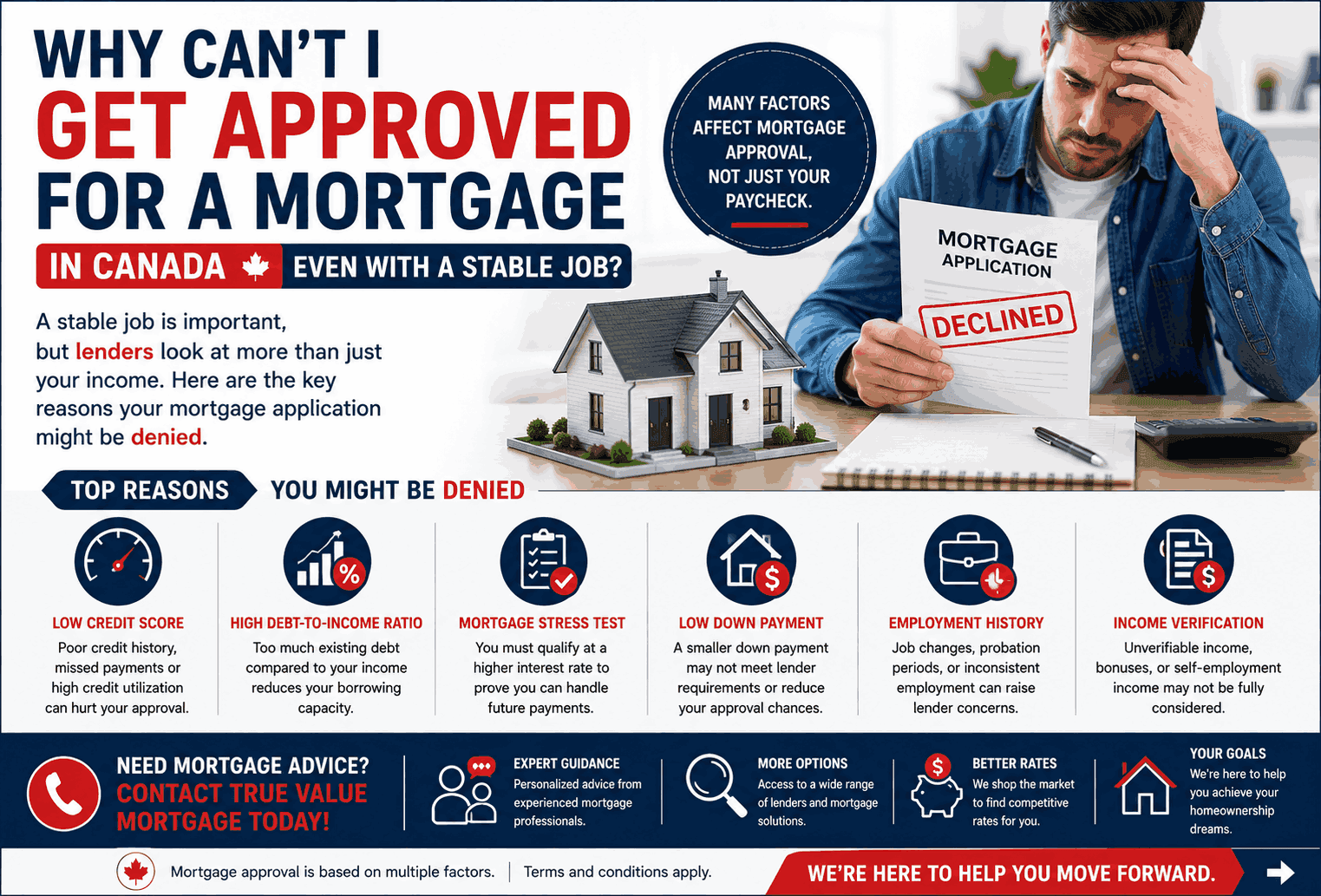
Getting a stable job is often considered one of the biggest milestones toward homeownership. So, it can be frustrating and confusing when your mortgage application is denied, even though you have a steady income and a full-time job.
The truth is that employment alone doesn’t guarantee mortgage approval in Canada. Lenders evaluate multiple financial and personal factors before deciding whether to approve your application. Your credit history, debt levels, down payment, employment stability, and overall financial profile all play an important role in determining your eligibility.
Whether you’re a first-time home buyer, self-employed professional, newcomer to Canada, or someone looking to refinance, understanding why your mortgage application was declined is the first step toward improving your chances of approval.
In this guide, we’ll explore the most common reasons mortgage applications are rejected in Canada and share practical tips to help you qualify with confidence.
How Do Canadian Lenders Decide Mortgage Approval?
When reviewing your application, banks and mortgage lenders don’t just focus on how much you earn—they assess whether you can comfortably manage your mortgage payments over the long term.
Some of the key factors lenders evaluate include:
- Employment status and income stability
- Credit score and credit history
- Debt-to-income ratio (DTI)
- Gross Debt Service (GDS) ratio
- Total Debt Service (TDS) ratio
- Down payment amount
- Property value and appraisal
- Savings and financial reserves
- Existing loans and monthly obligations
- Mortgage stress test qualification
A strong application demonstrates not only consistent income but also responsible financial management.
1. Your Credit Score Is Too Low
One of the most common reasons for mortgage rejection in Canada is a low credit score.
Your credit score gives lenders insight into how responsibly you’ve managed credit in the past. Even if you have a stable salary, missed payments, high credit card balances, or defaults can negatively affect your application.
Generally, a higher credit score can improve your chances of qualifying for competitive mortgage rates. However, lenders also review your overall credit history—not just the score itself.
How to improve your credit profile:
- Pay all bills on time.
- Reduce outstanding credit card balances.
- Avoid applying for multiple new credit accounts within a short period.
- Review your credit report regularly and dispute any errors.
- Keep older credit accounts open to maintain a longer credit history.
2. Your Debt-to-Income Ratio Is Too High
A good salary doesn’t automatically mean you qualify for a mortgage if you already have significant monthly debt.
Lenders calculate your Debt-to-Income (DTI) ratio to determine how much of your monthly income is already committed to existing financial obligations.
These may include:
- Credit card payments
- Car loans
- Student loans
- Personal loans
- Lines of credit
- Child support or other recurring obligations
If too much of your income goes toward existing debt, lenders may consider you a higher lending risk—even with stable employment.
Tip:
Paying down high-interest debt before applying for a mortgage can significantly improve your approval chances.
3. You Don’t Meet the Mortgage Stress Test
In Canada, many borrowers must qualify under the mortgage stress test, which ensures they can continue making payments even if interest rates increase.
This means you must demonstrate that you can afford mortgage payments at a higher qualifying rate than your actual mortgage rate.
Many applicants with good jobs are surprised to learn they don’t qualify because the stress test reduces the maximum mortgage amount they can borrow.
Working with an experienced mortgage broker can help you understand how the stress test applies to your financial situation and identify lenders or mortgage products that may better suit your needs.
4. Your Down Payment Isn’t Enough
Your down payment plays an important role in mortgage approval.
While some buyers qualify with the minimum required down payment, having a larger down payment can:
- Reduce your loan amount.
- Lower monthly mortgage payments.
- Improve lender confidence.
- Increase your chances of approval.
- Potentially reduce borrowing costs.
If your savings are limited, lenders may have concerns about your overall financial preparedness and ability to manage unexpected expenses after purchasing a home.
5. Your Employment History Isn’t Consistent
Having a stable job today doesn’t necessarily mean your employment history meets lender requirements.
Mortgage lenders often review:
- Length of employment
- Industry stability
- Probationary periods
- Recent job changes
- Income consistency
- Employment type (full-time, part-time, contract, or self-employed)
For example, if you’ve recently switched jobs or are still within a probation period, some lenders may require additional documentation before approving your mortgage.
Similarly, seasonal, commission-based, or contract workers may need to provide a longer history of stable earnings.
6. Your Income Doesn’t Qualify
Not all income is treated equally during the mortgage approval process.
Lenders may assess:
- Base salary
- Overtime income
- Bonuses
- Commission earnings
- Self-employment income
- Rental income
- Investment income
Some income sources require a documented history over one or two years before they can be fully considered.
If a significant portion of your earnings comes from bonuses or commissions, lenders may calculate your qualifying income differently than your actual annual income.
Why Working with a Mortgage Broker Makes a Difference
Many borrowers apply directly through their bank, assuming it’s their only option. However, every lender has different lending criteria, risk tolerance, and mortgage programs.
A professional mortgage broker works with multiple lenders and can help identify options that align with your financial profile. They can also review your application before submission, explain areas that may need improvement, and recommend strategies to strengthen your approval chances.
Instead of relying on a one-size-fits-all approach, working with an experienced broker can save time, reduce unnecessary credit inquiries, and improve the likelihood of finding a mortgage solution that fits your needs.
7. You Recently Changed Jobs
Starting a new job can be exciting, but if you’ve recently switched employers, lenders may want additional assurance that your income is stable.
If you’re:
- Still in a probation period
- Working on a temporary contract
- Changing industries
- Earning commission-based income
Some lenders may view your application as higher risk.
Tip: If possible, wait until you’ve completed your probation period before applying for a mortgage, or work with a mortgage broker who can connect you with lenders that are more flexible with employment changes.
8. The Property Doesn’t Meet the Lender’s Requirements
Sometimes, it’s not your finances that cause a mortgage application to be declined—it’s the property itself.
Lenders consider factors such as:
- Property condition
- Market value
- Location
- Type of property (condo, townhouse, detached home, rural property)
- Appraisal results
If the property’s appraised value is lower than the purchase price or it doesn’t meet the lender’s guidelines, your mortgage may be reduced or declined.
9. Missing or Incomplete Documentation
Mortgage approvals rely on accurate documentation. Missing paperwork can delay or even result in a declined application.
Typical documents include:
- Government-issued ID
- Employment letter
- Recent pay stubs
- T4 slips or Notices of Assessment
- Bank statements
- Down payment verification
- Credit information
Submitting complete and accurate documents helps lenders process your application more efficiently.
10. You Applied to the Wrong Lender
Every mortgage lender has different qualification criteria. A bank that declines your application doesn’t necessarily mean every lender will.
Some lenders specialize in:
- First-time home buyers
- Self-employed borrowers
- Newcomers to Canada
- Clients with bruised credit
- Investment property financing
- Mortgage refinancing
This is one of the biggest advantages of working with an experienced mortgage broker—they can compare multiple lending options instead of limiting you to one institution.
How to Improve Your Mortgage Approval Chances
If your mortgage application was declined, don’t lose hope. Many borrowers are approved after making a few strategic improvements to their financial profile.
Improve Your Credit Score
Pay bills on time, reduce outstanding balances, avoid missed payments, and regularly review your credit report for errors.
Reduce Existing Debt
Lowering your debt-to-income ratio by paying off credit cards, personal loans, or vehicle financing can significantly strengthen your application.
Save a Larger Down Payment
A larger down payment reduces the amount you need to borrow and demonstrates financial stability to lenders.
Avoid Taking on New Debt
Before applying for a mortgage, avoid financing vehicles, opening new credit cards, or making large purchases that increase your monthly obligations.
Organize Your Financial Documents
Preparing all required paperwork in advance helps avoid unnecessary delays and demonstrates financial responsibility.
Get Pre-Approved
Mortgage pre-approval provides a clearer picture of your borrowing capacity and identifies potential issues before you begin shopping for a home.
Why Choose True Value Mortgage?
At True Value Mortgage, we understand that every borrower’s financial situation is unique. Whether you’re buying your first home, renewing your mortgage, refinancing, or facing challenges with mortgage approval, our experienced team is here to guide you every step of the way.
We help with:
- First-Time Home Buyer Mortgages
- Mortgage Pre-Approval
- Mortgage Refinancing
- Mortgage Renewals
- Home Equity Financing
- Self-Employed Mortgages
- Newcomer Mortgages
- Alternative Lending Solutions
- Investment Property Mortgages
- Debt Consolidation Mortgages
Our goal is to simplify the mortgage process, compare competitive lending options, and help you secure a solution that fits your financial goals.
Final Thoughts
A stable job is undoubtedly an important factor in obtaining a mortgage, but it is only one part of the overall picture. Canadian lenders assess your complete financial profile—including your credit history, debt obligations, down payment, employment stability, and ability to handle future mortgage payments.
If your mortgage application has been declined, it doesn’t necessarily mean homeownership is out of reach. By understanding the reasons behind the decision and taking proactive steps to strengthen your financial profile, you can improve your chances of approval.
Working with an experienced mortgage broker can make the process much easier by helping you identify suitable lenders, avoid common mistakes, and explore financing options tailored to your unique circumstances.
Ready to Improve Your Mortgage Approval Chances?
Don’t let one declined application stop you from achieving your dream of homeownership.
Contact True Value Mortgage today for expert mortgage advice, personalized financing solutions, and access to multiple trusted lenders across Canada. Whether you’re purchasing your first home, refinancing an existing mortgage, or looking for better mortgage options, we’re here to help you move forward with confidence.
Frequently Asked Questions
Q1. Can I get a mortgage in Canada with a stable job but bad credit?
Yes. While approval may be more challenging, some lenders and alternative mortgage solutions are available depending on your financial profile.
Q2. What credit score is generally recommended for a mortgage in Canada?
A stronger credit score generally improves your chances of approval and may help you qualify for more competitive interest rates.
Q3. What is the mortgage stress test?
The mortgage stress test measures whether you can continue making mortgage payments if interest rates increase.
Q4. Can I qualify if I’m self-employed?
Yes. Self-employed borrowers can qualify by providing the required income documentation and meeting lender guidelines.
Q5. Does changing jobs affect mortgage approval?
It can. Recent employment changes or probation periods may require additional review by lenders.
Q6. How much down payment do I need?
The minimum down payment depends on the purchase price of the property and current Canadian mortgage regulations.
Q7. Should I get pre-approved before buying a home?
Yes. Pre-approval helps determine your budget and identifies potential qualification issues early.
Q8. Can a mortgage broker help after a mortgage is declined?
Absolutely. Mortgage brokers have access to multiple lenders and can help identify alternative financing options.
Q9. Does paying off debt improve mortgage approval?
Yes. Lower debt levels can improve your debt-to-income ratio and strengthen your application.
Q10. Why choose True Value Mortgage?
True Value Mortgage provides expert guidance, personalized mortgage solutions, and access to a wide network of lenders to help clients achieve their homeownership goals.